
A little Life in England – How a Flea Treatment Probably Poisoned My Dog
And how a vet physiotherapist and a ketogenic diet helped diagnose and cure my Jack Russell’s resulting seizures.

We never used to treat dogs all the time for fleas
When I was growing up we only treated our dogs for fleas when they had fleas. And when they had ticks we removed them. But now dog owners are advised to treat their dogs continuously to prevent them from being bitten by fleas or ticks.
Before we came back to England, I never treated Molly for fleas or ticks. Canterbury, New Zealand doesn't have ticks, and fleas are rare because of the dry summers and cold winters. But I knew many people who gave their dogs regular flea treatments. Molly's friend, Jack the Russ, used to hate it so much he would sulk for the next 24 hours (which is why his owners once tricked us into giving him his flea treatment).
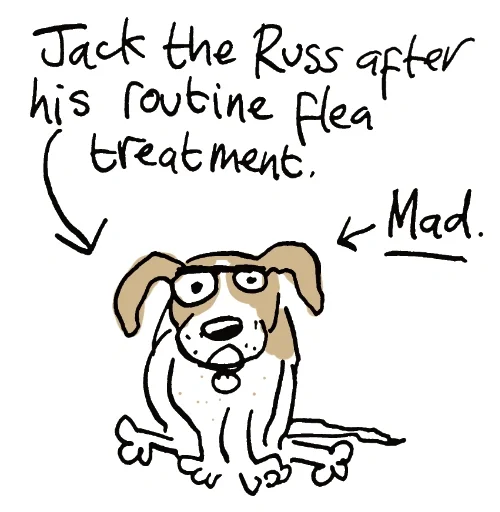
And he's not the only one who is affected by these treatments.
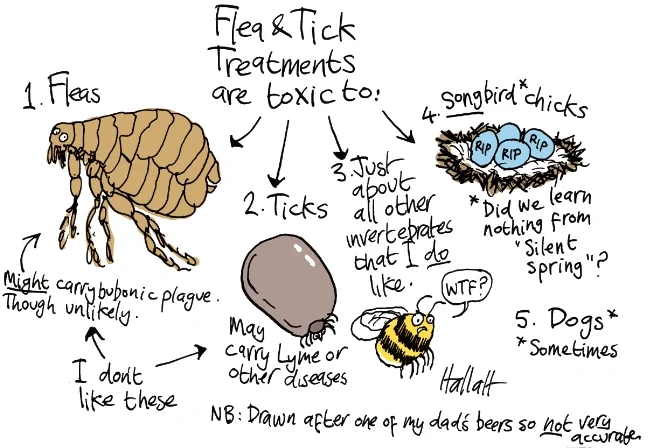
Flea treatment chemicals are poisoning our waterways and killing songbirds
Recent research shows that flea treatment chemicals are getting into waterways and killing insect life, and the fur that comes from our pets is ending up in songbird nests where it kills the offspring.
University of Sussex researchers found fipronil, a chemical mostly widely used in pet flea treatment, in 98% of freshwater samples. Imidacloprid, another pesticide found in pet flea treatment, was found in 66% of samples. Their recent research discovered harmful chemicals from pet flea treatments in every songbird nest they examined, with the contaminated pet fur used by birds to line their nests killing chicks.
Flea treatments are seriously toxic to our environment.
But why am I writing about this for an epistle that is usually about our little life in England?
Because a flea treatment led to a horrible introduction to England for Molly, my Jack Russell.
I made a terrible mistake
Molly had to be treated for fleas before flying and I made a big mistake.
I knew she would have a worming tablet just before her flight, but I thought she would only be checked for external parasites. I wanted her to pass this check so I treated her with Bravecto five weeks before her flight. When I told the vet this he called the manufacturer, MSD (Merck Sharp & Dohme) to see whether it would be safe to give Molly the extra dosage as Bravecto is usually given every three months. MSD's vet said it was off-label, but their studies had used much higher doses and it was safe. Later when I read the information sheet, I found that it had not been proven safe at intervals of less than eight weeks. And that it could cause seizures.

Molly’s strange turns
Two days after Molly arrived in the UK and one day after I arrived I saw the first of her strange turns. She looked like she was in pain, contorted and held up her paw.
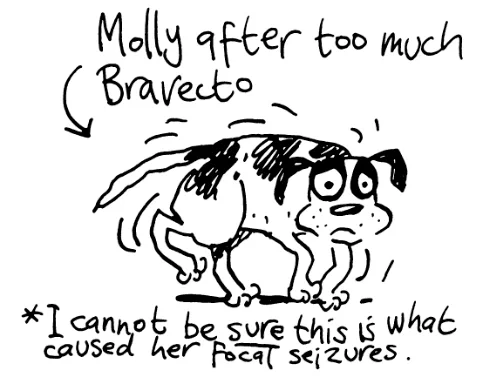
Later on these turns became worse and she would also vomit. I didn't connect it to the flea treatment at the time, only to the 30+ hours she had been confined in a crate. Of course correlation doesn't always mean causation.
I took her to a vet who looked at the video I had taken, examined Molly and diagnosed a cruciate ligament problem. A £600 X-ray showed she had moderate hip dysplasia, but no ligament tear. The vet gave her painkillers and that was that. But Molly kept having the turns and I wanted to make her better.
Thank goodness for vet physiotherapists
I used Google Maps to find a vet physiotherapist called Olivia Lancaster. She was brilliant.
For little more than the cost of a 15 minute consultation with a vet, Olivia spent well over an hour with Molly. She said Molly did have lower back pain and probably sciatica. She was prescribed rest, TENS (electrotherapy)
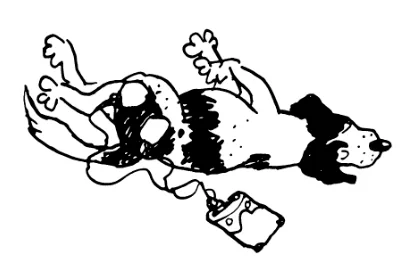
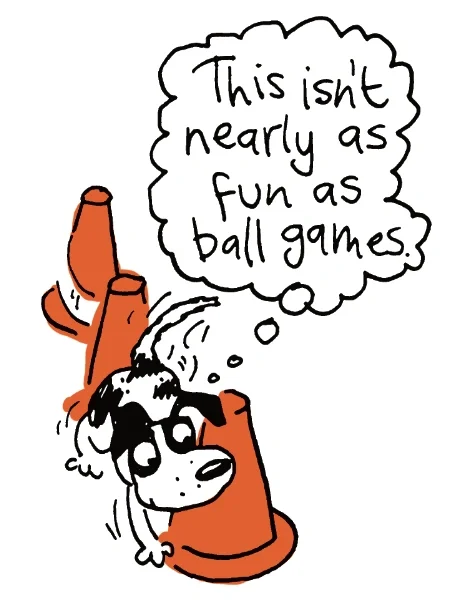
and exercise routines.
Molly improved dramatically on the pain front, with no more lower back pain evident after a couple of weeks. But the funny turns didn't go away.
Because the turns weren’t physical
Olivia suggested the turns might be neurological – focal seizures. As soon as I looked up the symptoms of focal seizures it all made sense. The turns weren’t affected by exercise, or lack of. They happened at rest, after walking, in the middle of the night: randomly.
I knew that the flea treatment (fluralaner in Bravecto) affects the nervous system of the invertebrates it targets. And it appears that in some dogs or at some doses it can have the same effect on dogs.
I cannot blame the company that makes the flea treatment as it was not being used as prescribed. I cannot blame the vet for misdiagnosing her seizures as physical ailments because they have a limited amount of time to see the animals they deal with. But I was so grateful that a vet physiotherapist made the connection and that my biochemistry background allowed me to figure out a solution.
A ketogenic diet stopped the seizures
I have friends whose migraines have responded well to a ketogenic diet. Migraines, like seizures, involve abnormal electrical activity in the brain. I looked up whether focal seizures could respond to the same kind of low-carbohydrate diet. There were a few case studies on epilepsy in dogs that suggested they might. It was worth a try.
By this point Molly was having 3 to 6 seizures a day and I was really worried. The alternative was drug therapy that had its own side-effects. But on day seven of the ketogenic diet, Molly's seizures stopped. She was seizure-free for 18 days.
I was making her food and made a batch that had a little more sweet potato and carrot in it than before (ie. more carbohydrate, providing energy to the brain in the form of glucose, not ketones). Three days later, the seizures returned. I made a new batch (my sister's dog Oreo was the grateful recipient of the non-ketogenic home-made dog food).
Again, seven days later, the seizures stopped. As I write this, she has been seizure-free for a week. It will be a long time before I take her off this diet unless I have to. We went to the vet today and she had blood tests to make sure that the diet is not causing other problems.
Fingers and paws crossed.
I will never give my dog routine flea treatments again
I will never again give Molly unnecessary flea treatment. The routine prescription of flea medication is madness. Many people I talk to tell me that their dogs hate it. And these powerful drugs are not only putting dogs at risk of neurological damage, they are also harming other invertebrates and animals further up the food chain.
We pet owners are exposed to the ticks and other biting insects too. But we don't take drugs routinely to prevent that in the UK. We use deterrent sprays or cover up and we might check ourselves when we come in from a walk in the woods. This is what I shall be doing with Molly in the future. Because I care about her and the environment we live in.
I question the motive of pharmaceutical companies encouraging vets to prescribe neurotoxic drugs on a routine basis.
Thank you for being one of the good humans.
Alex
P.S. Molly is back to her normal, happy, active self. Though I am becoming tired of home cooking all her meals.
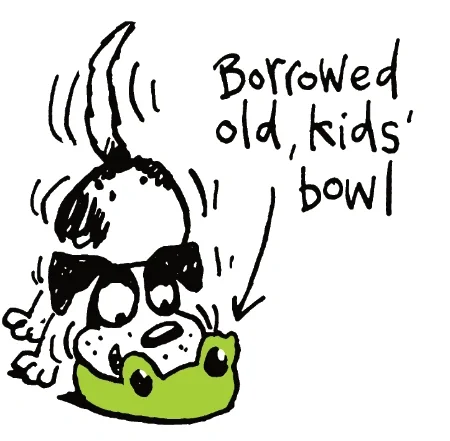
(From my illustrated epistle for paid subscribers sent on 14th August 2025)